DNA Kiddo
Launch promo ends in 00:00:00
DNA KiddoA field guide to inherited traits

Your child is not a blend of two parents. They are a new draw from a very old deck.

Two hundred inherited traits, from a widow's peak to an altitude gene inherited from Denisovans — each one named, traced to the gene behind it, and placed on the map. Written as a field guide, and honest about what genetics cannot tell you.

Instant download · Yours forever
200Entries
76Pages
10Parts
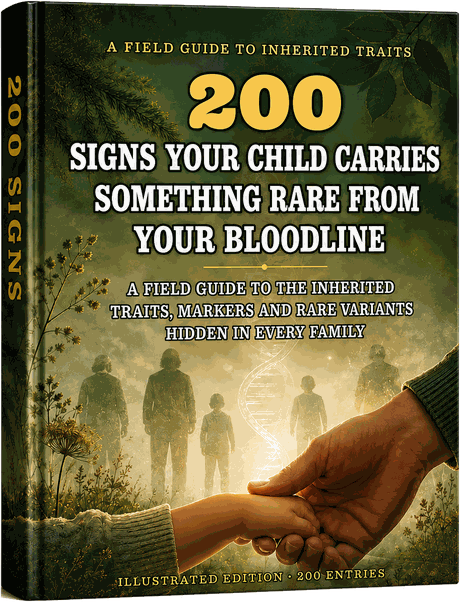
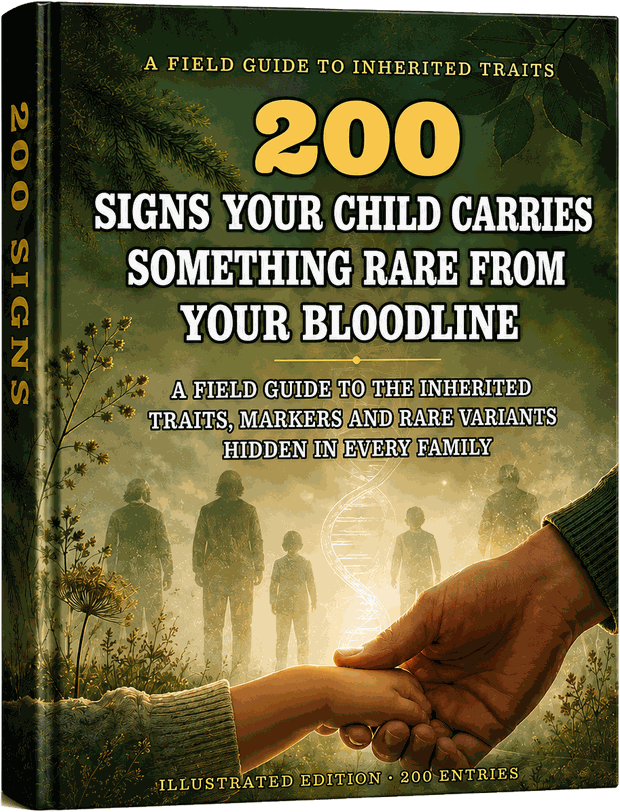
200 Signs Your Child Carries Something Rare From Your Bloodline — illustrated first edition

“Two hundred signs. One child. A combination that has never existed before.”

The sentence the book ends on

A fold of skin at the corner of an eye. A scooped ridge behind a front tooth. An enzyme that should have switched off at weaning and never did. Each one is the visible end of a specific instruction, and each instruction can be traced — to a gene, to a moment in history, to a part of the world.

This book collects two hundred of those marks. They are grouped by where on the body they appear rather than by how they are inherited, because that is how families actually notice them: someone looks at a baby's hands and says, those are my mother's hands.

Real Voices

“Entry 002 settled a forty-year argument in my family. A cleft chin is a bone story, not a skin one — the two halves of the jaw fuse and sometimes leave a seam. That is why my brother has it and I do not. Nobody had ever explained it that way.”

Raymond K. Raymond K.58, Arizona

“I bought it for the hands and stayed for Part Three. My granddaughter had the blue-grey mark at the base of her spine and her mother was frantic — entry 069 explained it in four sentences and said it fades on its own.”

Marilyn L. Marilyn L.64, Oregon

“The timeline is worth the price on its own. Brown eyes and type O blood are older than our species; blue eyes and adult milk digestion are younger than the pyramids. I have read that page out loud to four people.”

Tom B. Tom B.61, Ontario
4.9 / 5 stars · read by over 3,000 families
Visa · Mastercard · Amex · PayPal — secure checkout by Gumroad
I

Those are my mother's hands

Every family says some version of it. Almost no family knows what they are actually looking at.

Somewhere in your family there is a trait that keeps coming back. A peak in the hairline. A gap between the front teeth. A child who cannot fall asleep before two in the morning and never could. An aunt whose eyes changed colour at four years old. A cousin who sneezes walking out into bright sun.

School taught you that these things are simple — one gene, dominant or recessive, a little square grid on the blackboard. Almost all of that was wrong. Tongue rolling, attached earlobes, the hitchhiker's thumb, the widow's peak: every one of them turned out on investigation to be nothing like the tidy story, and the real explanations are considerably more interesting than the fiction they replaced.

The widow's peak is not a switch inherited from one parent. It is a cluster of genes governing how the skin and follicles of the forehead migrate during the eighth week of pregnancy — and the cluster tends to travel together, which is why the same peak reappears at the same sharpness, generation after generation.

This is a field guide to two hundred of the marks a bloodline actually leaves. Each entry names the trait in the words a family would use, explains what is genuinely known about the mechanism and how confidently it is known, then gives you two lines: TRACE, the gene, marker or developmental process involved, and FOUND, where in the world the trait is common.

You read it the way you read a bird book. Start anywhere. Find the entries that describe someone in your family. Then look at the FOUND lines — because traits that cluster in the same region of the world are often telling you the same thing twice, and that repetition is the signal worth paying attention to.

What it will not do is tell you what your child is like. Nothing in these two hundred entries touches temperament, intelligence, character or worth, and the book says outright that any book claiming to read those things off a face is selling something. The traits here are structural, chemical and sensory. They are interesting precisely because they are modest.

II

The Difference

There are three ways a family usually tries to answer this question. Only one of them is a book.

 This field guideA consumer DNA kitAn afternoon of searching
What it costs$14.99, once$99–$199, plus a subscription for most featuresNothing
What it actually tells youWhat each visible trait is, how it forms, and where in the world it is commonAn ancestry percentage estimate and a small set of health reportsWhatever ranks highest today
The marker behind the traitNamed for all 200 entries — gene, variant or developmental processNot covered for most visible traitsUsually the school version, repeated
The mythsCorrected explicitly, with what is actually happening insteadNot addressedReinforced
Your dataYou send nothing. No sample, no account, nothing leaves your houseA saliva sample and a genome held on fileA search history
Who can use itEveryone in the family, tonight, on any deviceOne person, one kitAnyone
Time to the first answerAbout a minute per entryFour to eight weeksMinutes, unverified
Honest about its limitsA closing note on exactly what none of it can tell youBuried in the termsRarely
Swipe the table sideways →
III

What's Inside

The real contents of the illustrated first edition — 76 pages, 200 numbered entries, original line drawings throughout.

001

A Widow's Peak

Not a simple dominant switch. The frontal hairline is shaped by several genes governing how the forehead's skin and follicles migrate in the eighth week of pregnancy — and the whole cluster of variants tends to travel together.

Trace Polygenic; frontal hairline patterning
Found Roughly one third of people worldwide
050

Very Thick, Straight Hair

A single letter change at position 370 of the EDAR gene, arisen in East or Central Asia around thirty-five thousand years ago, simultaneously thickened the hair shaft, multiplied sweat glands and reshaped the front teeth.

Trace EDAR V370A
Found Over 90% of East Asian and Indigenous American people
149

Thriving at High Altitude

Tibetan populations carry an EPAS1 variant allowing efficient oxygen use without thickening the blood — inherited from Denisovans, an archaic human population. The clearest case of ancient interbreeding producing a modern advantage.

Trace EPAS1, Denisovan-derived
Found Nearly 90 percent of Tibetans

200 Signs Your Child Carries Something Rare From Your Bloodline

Illustrated edition · 76 pages · 200 entries · ten parts
Before the entries
  • Before You Read — what “rare” means here in three different senses, what the book will not do, and how to use it
  • How to Read an Entry — the four parts of every entry, shown on a worked example
  • The Rules Underneath — two carriers and one hidden variant, and why inheritance looks like skipping when nothing was skipped
  • Where They Came From — three hundred thousand years compressed into one timeline: the first modern humans, the migration out of Africa, EDAR, the crossing of Beringia, the beginning of farming, the steppe movement into Europe
The ten parts
  • Part OneThe Architecture of the FaceSigns 1–22
  • Part TwoEyes and How They Are BuiltSigns 23–44
  • Part ThreeHair, Scalp and the Surface of the SkinSigns 45–70
  • Part FourHands, Feet and the Shape of BoneSigns 71–92
  • Part FiveThe Mouth, the Teeth and the VoiceSigns 93–114
  • Part SixThe SensesSigns 115–136
  • Part SevenBody Chemistry — Taste, Tolerance and MetabolismSigns 137–158
  • Part EightBlood, Immunity and the Deep MarkersSigns 159–178
  • Part NineSleep, Rhythm and MovementSigns 179–192
  • Part TenRare Family PatternsSigns 193–200
And at the end
  • Closing — a note on rarity, and on what none of this can tell you
  • Before you act on anything in this book — the small number of findings genuinely worth a professional look, and why
Get The Book — $14.99 Instant download · read on any phone, tablet or computer
IV

About this edition

Written to be read by families, and honest about what genetics can and cannot say.

DNA Kiddo publishes one kind of thing: careful, readable field guides about inherited human variation, made for the people who actually notice it — parents, grandparents, and anyone who has looked at a new baby and recognised a face from an old photograph.

This first edition took its shape from a single rule. Every entry had to name its own evidence. Where the mechanism is well established, the book says so and names the gene. Where the popular account is wrong, it says that too, and explains what is actually happening instead — those corrections turned out to be some of the best material in the collection. Where the science is genuinely unsettled, as with whether epigenetic marks reliably transmit to a third generation in humans, it is described as unsettled rather than dressed up.

The design follows the same discipline: warm cream stock, numbered entry roundels, small-caps TRACE and FOUND lines beneath every entry, and original line drawings created for this edition — including diagram pages for the inheritance patterns and for the three-hundred-thousand-year timeline.

Two hundred entries is a great many ways of saying the same thing: that a child is made of history, that almost none of it is dramatic, and that all of it is theirs.

It is delivered as a PDF, immediately, and it is yours to keep and to read on anything you own.

V

Questions

The ones worth answering before you buy.

Is this real science, or is it the usual internet genetics?

Every entry names the gene, variant or developmental process it is describing, and states how confidently that mechanism is known. A great deal of the book is spent correcting the usual internet genetics — the widow's peak, the hitchhiker's thumb, tongue rolling, attached earlobes and single dimples are each handled by explaining what is actually going on rather than repeating the classroom version.

It is careful in the other direction too. Frequencies are given as population averages and explicitly described as saying nothing definitive about any individual, and no trait is presented as establishing ancestry on its own.

There is plenty of free material about genetics online. Why pay for this?

Because the free material is scattered, unranked, and mostly wrong about the exact traits families ask about. What you are buying is two hundred entries in one numbered sequence, each about a minute to read, each carrying the marker behind it and the part of the world where it is common — organised by where on the body the trait appears, which is the only order a family will ever actually use.

You are paying for the sorting and the checking, not for the facts.

Why is it only $14.99?

It is a digital file. There is no printing, no warehouse and no shipping, so the price reflects what the writing and the illustration cost rather than what a hardback costs to move around the world. $14.99 is the launch promotion; the list price is $29.99.

How do I get it, and what format is it?

Checkout runs through Gumroad. The PDF is emailed to you within about sixty seconds of payment, and there is also a download link on the confirmation page. It opens on any phone, tablet, laptop or e-reader. Instant download, yours forever.

Is this the whole book, or a sample?

The whole book. All 200 numbered entries across ten parts, the four front-matter chapters, both diagram pages, the closing note and every illustration — 76 pages, the complete illustrated first edition. There is no second volume to buy and no upsell after checkout.

Will it tell me my child's ancestry?

No, and it says so plainly. Ancestry as used here means genetic population history, which is not the same thing as identity, nationality, culture or family belonging — and no physical trait establishes ancestry on its own. What the book gives you is the FOUND line: where in the world each trait is common. When several traits in one family point at the same region, that repetition is interesting. It is still not a test.

Is any of this medical advice?

No. It is written for general education and family interest only, it is not a diagnostic tool, and it must not be used to assess, diagnose or rule out any condition in a child or an adult.

A small number of entries carry a note recommending a conversation with a doctor — a preauricular pit, a white forelock present from birth, six or more café-au-lait spots, a family history of early heart disease, a relative who reacted badly to anaesthesia, or hearing loss appearing in more than one family member. Those notes exist because the information is genuinely useful to a clinician, not because anything is likely to be wrong. If a question here matters to your family, a doctor or a genetic counsellor can answer it properly in about twenty minutes.

Can children read it?

It is written for adults, but it was written to be read aloud. Older children who like natural history tend to find the trait entries immediately gripping — particularly Part Six, on the senses, where two children standing in the same kitchen turn out to be tasting different things.

Get The Book — $29.99 $14.99
Instant download · Yours forever

The Illustrated First Edition

200 entries · ten parts · 76 pages · delivered in about sixty seconds

Before you go

Two hundred signs. One child.
A combination that has never existed before.

200 Signs Your Child Carries Something Rare From Your Bloodline

The illustrated first edition is $14.99 during the launch promotion, down from $29.99. It arrives in your inbox in about a minute.

Get The Book — $29.99 $14.99
Instant download · Yours forever